
- Start with the required function, not fabric colour or weight.
- Separation, filtration and protection are different jobs.
- The surrounding soil and aggregate influence selection.
- Check current product data before specifying laps and grades.
Separation
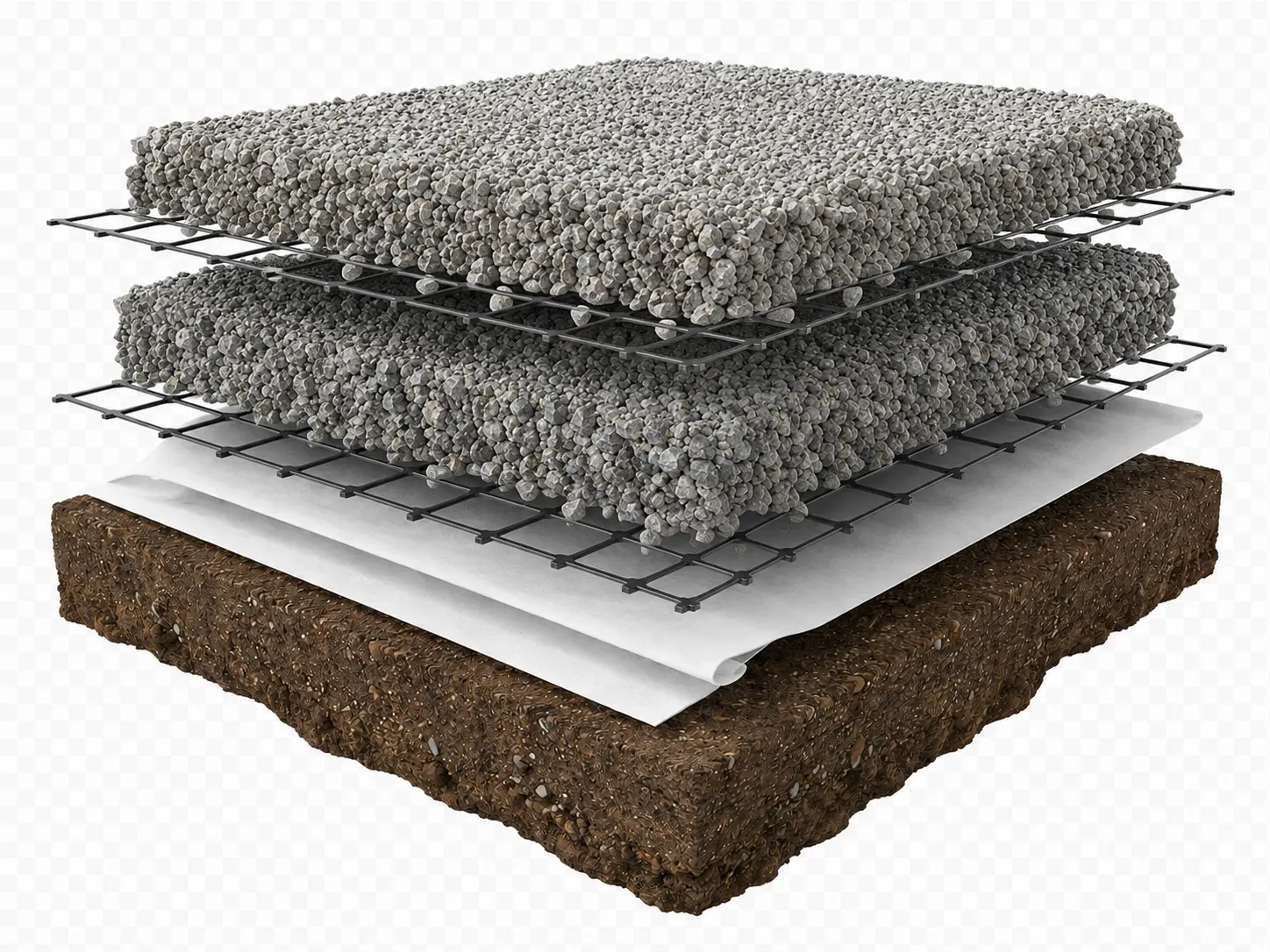
A separation geotextile sits between unlike materials, often a fine formation and a granular layer. It helps prevent the aggregate becoming contaminated by the soil beneath while allowing the designed build-up to retain its intended structure.
Separation is not simply a matter of placing any fabric under stone. Survivability during installation, opening size, tensile properties and the condition of the formation all matter.
Filtration
A filtration geotextile allows water to pass while controlling the movement of soil particles. The fabric needs to be considered alongside the grading and behaviour of the soil it is filtering.
A product that is appropriate for one soil may not be appropriate for another. Permeability and characteristic opening size should be checked against the intended application.
Protection and drainage
A nonwoven geotextile may be used to cushion or protect an adjacent membrane or drainage component. The required robustness depends on the substrate, placed materials, loading and construction method.
Some geotextiles also support drainage functions, but the complete water path still needs to be coordinated. A fabric does not create an outlet by itself.
A practical selection checklist
Define the job first, then compare current product data. If a specification only states a colour or mass per square metre, it may not define the performance that matters.
- Required function: separation, filtration, drainage or protection
- Formation soil and the aggregate placed above
- Water flow and filtration requirements
- Installation damage risk and required survivability
- Laps, joints, edges, penetrations and construction sequence
Evidence used for this guide
Questions about geotextiles
Is woven geotextile always stronger?
Not in every relevant sense. Different products report different tensile, puncture, filtration and hydraulic properties. Compare performance against the job the fabric must do.
Can geotextile stop weeds?
Civil geotextiles are selected primarily for engineering functions such as separation and filtration. Weed suppression is not a sufficient basis for selecting a fabric within a structural or drainage build-up.
Which side faces up?
That depends on the product and application. Follow the current installation information for the selected geotextile and coordinate laps and interfaces before work starts.