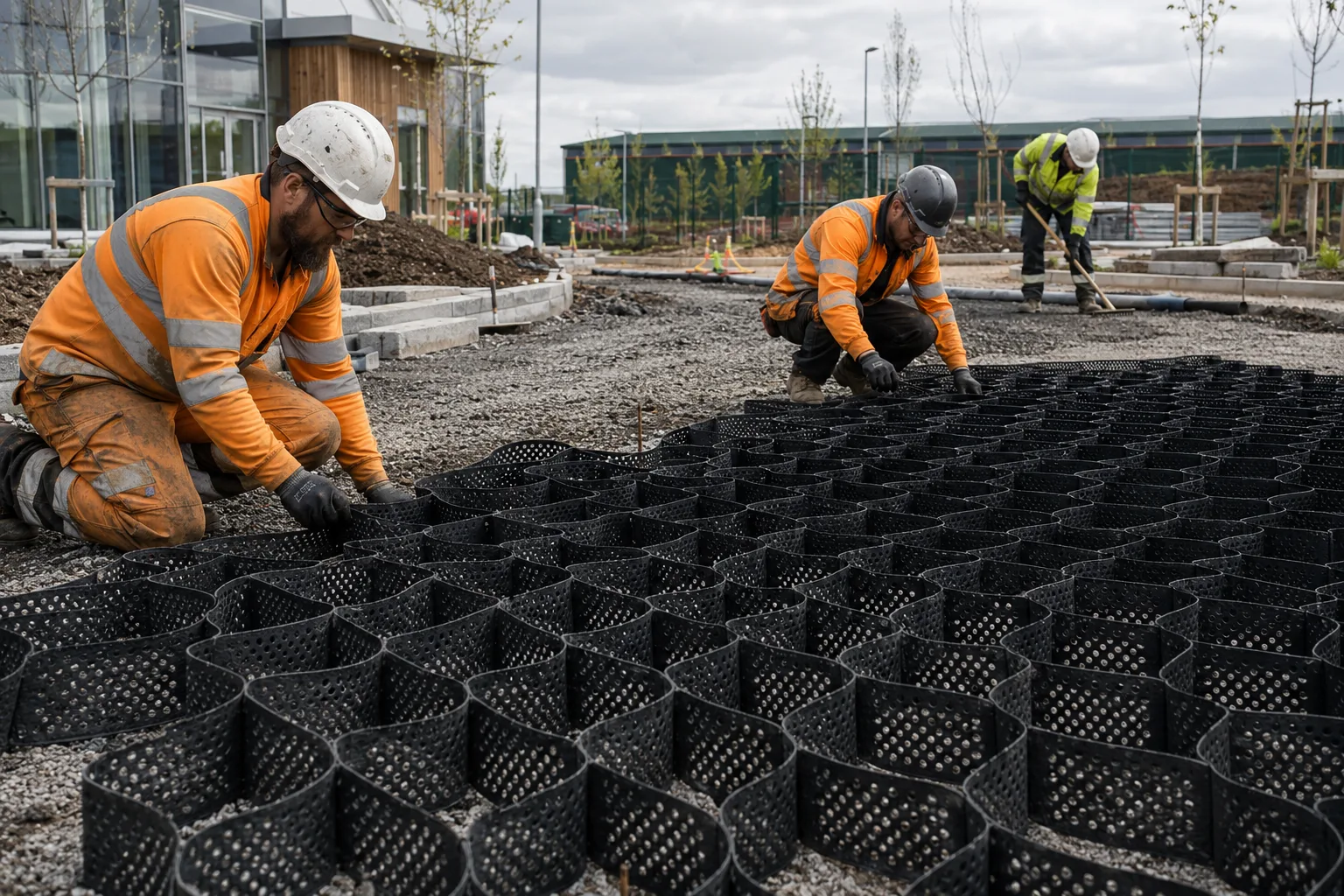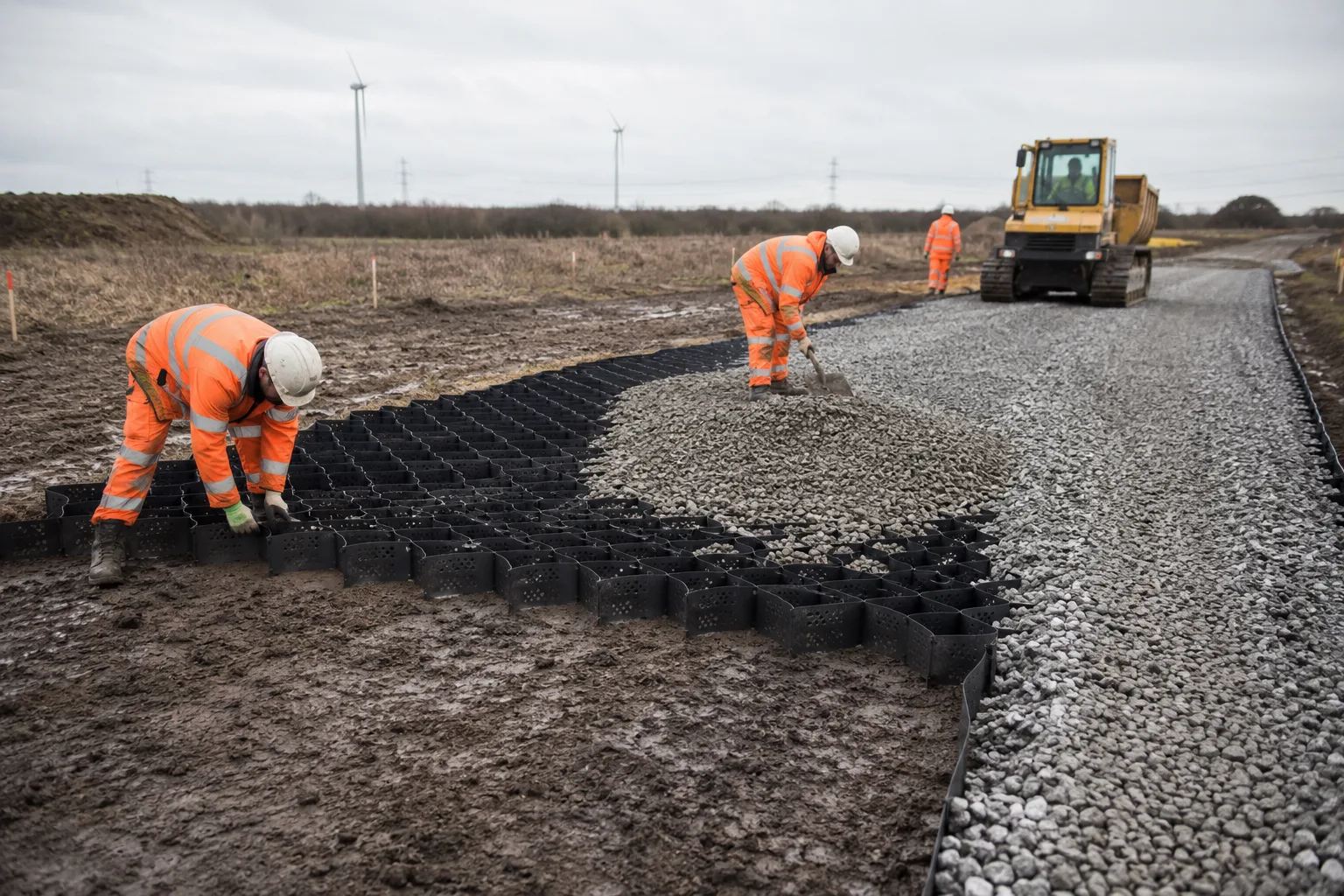
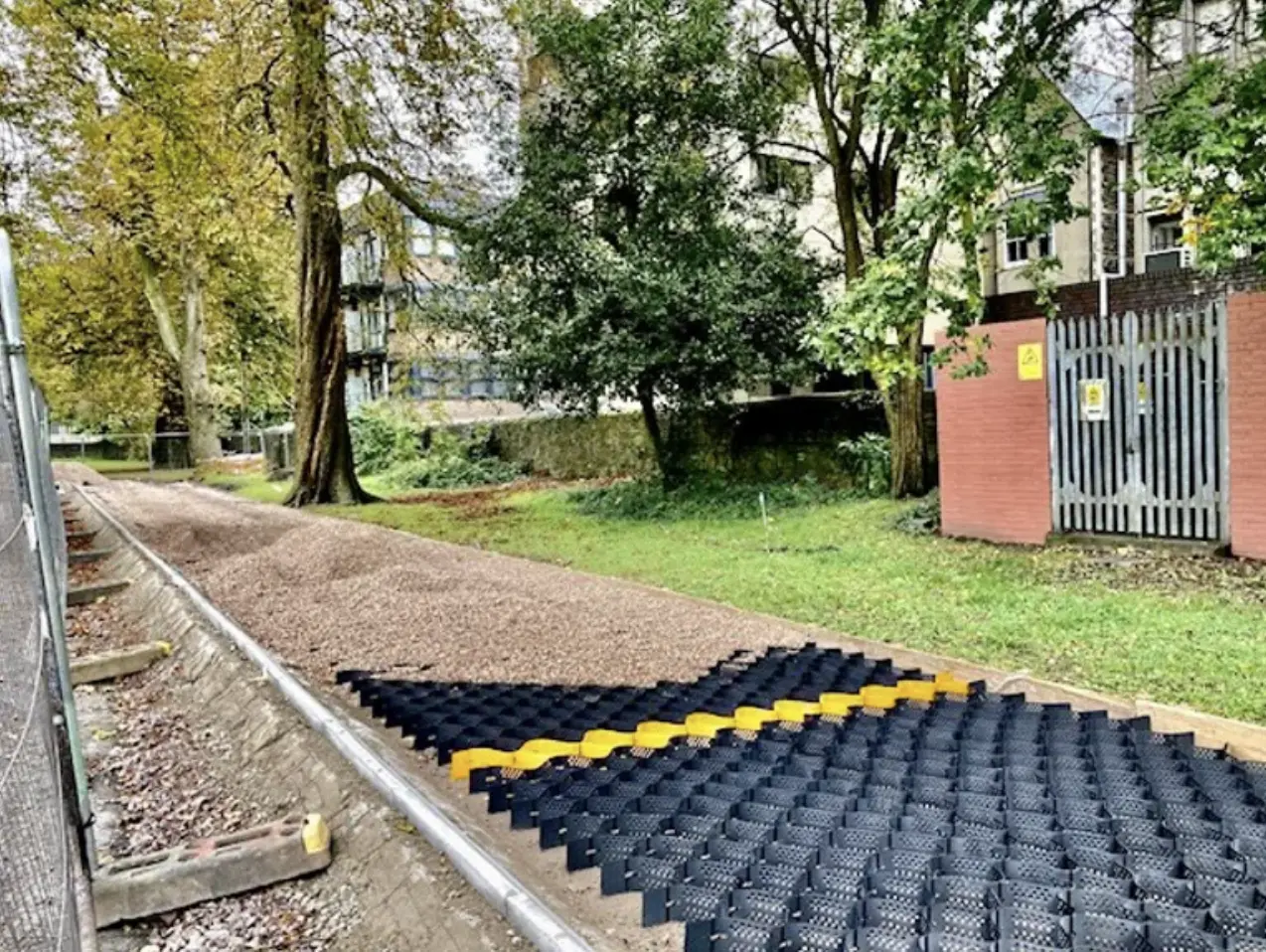
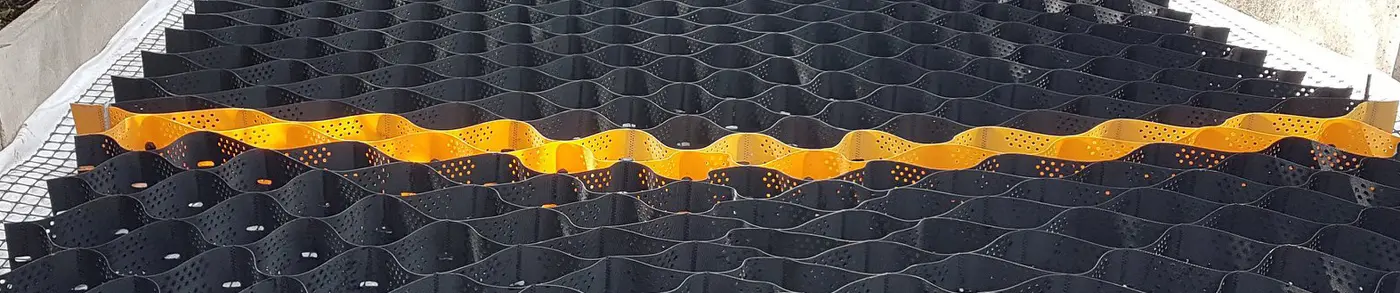
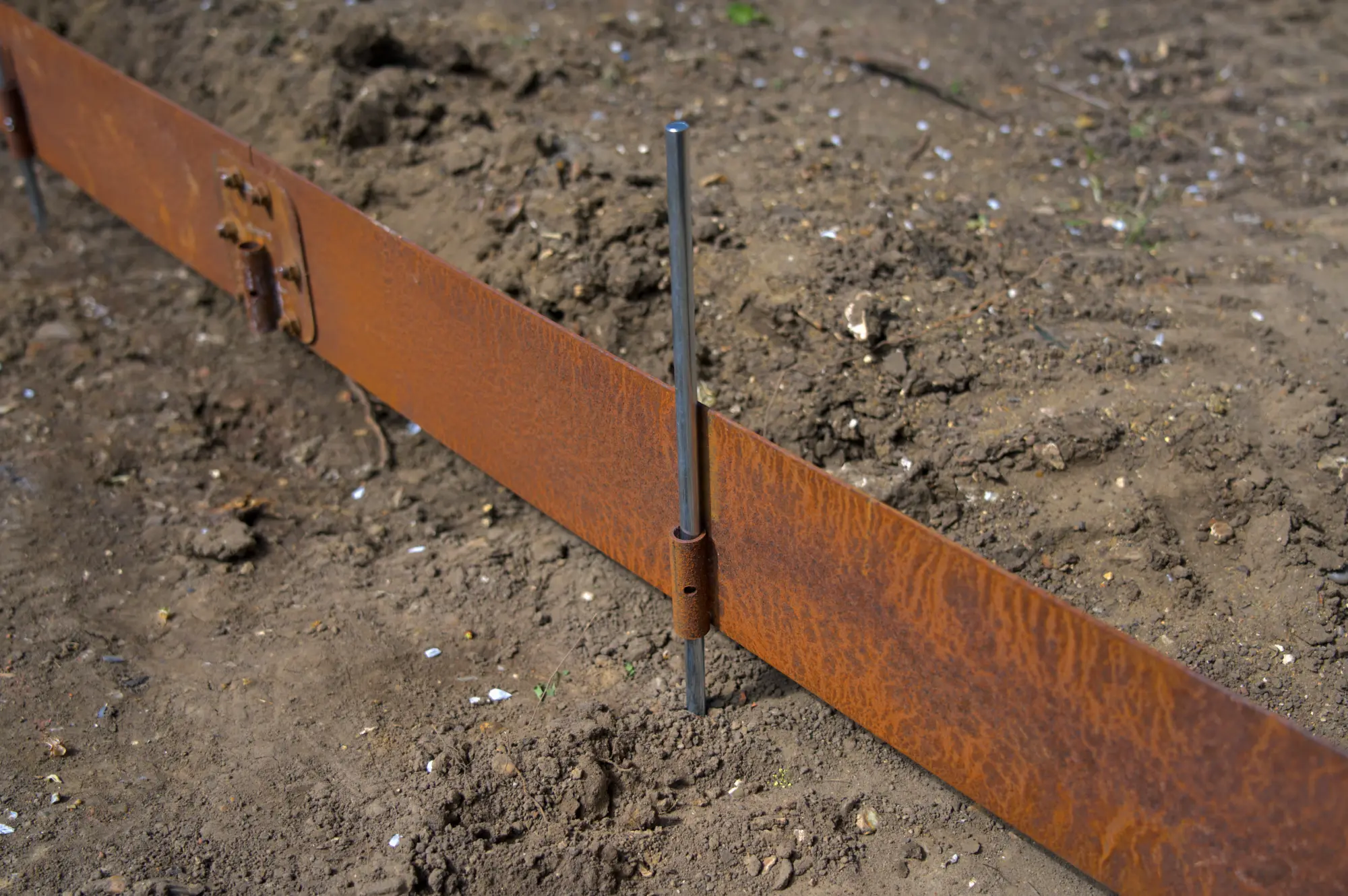
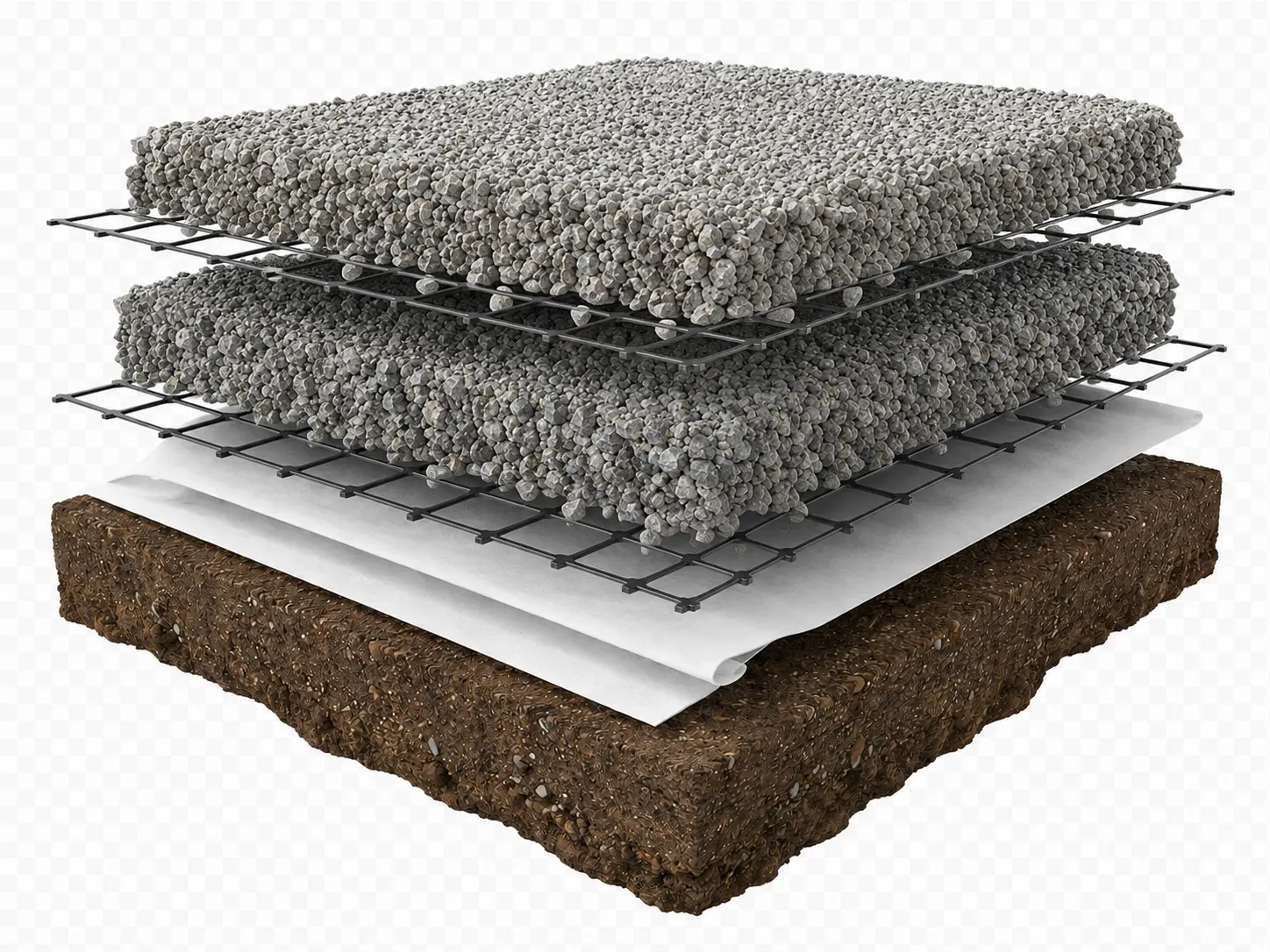
- Geocell provides three-dimensional confinement.
- Geogrid provides planar reinforcement through aggregate interlock.
- Either product may be used alone, or both may be used where each has a defined role.
- Selection starts with project information, not a generic claim that one product is stronger.
How geocell works
Geocell arrives as a compact panel and is expanded on site to form a connected cellular structure. Once the cells are filled, the walls restrict lateral movement of the selected aggregate or soil.
This confinement helps the infill behave as a more stable layer. Cell depth, the grade of the geocell, infill, compaction, drainage and edge restraint all affect the completed build-up.
How geogrid works
A geogrid is installed as a planar reinforcement layer. When compatible angular aggregate is placed and compacted, particles engage with the grid apertures. This interlock helps restrict lateral movement within the granular layer.
A biaxial, multiaxial, uniaxial or composite geogrid is not automatically interchangeable with another type. Grid geometry, stiffness, aggregate and the design method need to suit the intended function.
When would you use both?
A build-up can need more than one function. A geotextile may separate the formation from the aggregate, a geogrid may reinforce the granular layer, and a geocell may confine material nearer the surface.
More layers are not always better. Every component needs a clear purpose, compatible adjacent materials and a construction sequence that can be achieved on site.
Information needed before selection
The most useful first step is to define the ground, loading and proposed construction. If the information is incomplete, identify the gaps rather than selecting a product on depth or headline strength alone.
- Formation condition and known CBR or geotechnical information
- Vehicle type, axle loads, repetitions and intended design life
- Available aggregate and proposed layer depths
- Surface finish, levels, drainage and boundary conditions
- Construction access, sequencing and quality control
Evidence used for this guide
Questions about ground reinforcement
Is geocell stronger than geogrid?
That comparison is too simple because the products use different mechanisms. The better question is whether the project needs cellular confinement, planar interlock, or a build-up in which both have a defined role.
Can geogrid reduce sub-base depth?
Reinforcement can make some build-ups more efficient, but any reduction depends on the formation, loading, aggregate, reinforcement and design method. It should not be assumed from a generic product claim.
Does geocell always need geotextile beneath it?
No. A geotextile is added where separation, filtration or protection is required. Its function and grade should be selected for the actual ground and build-up.