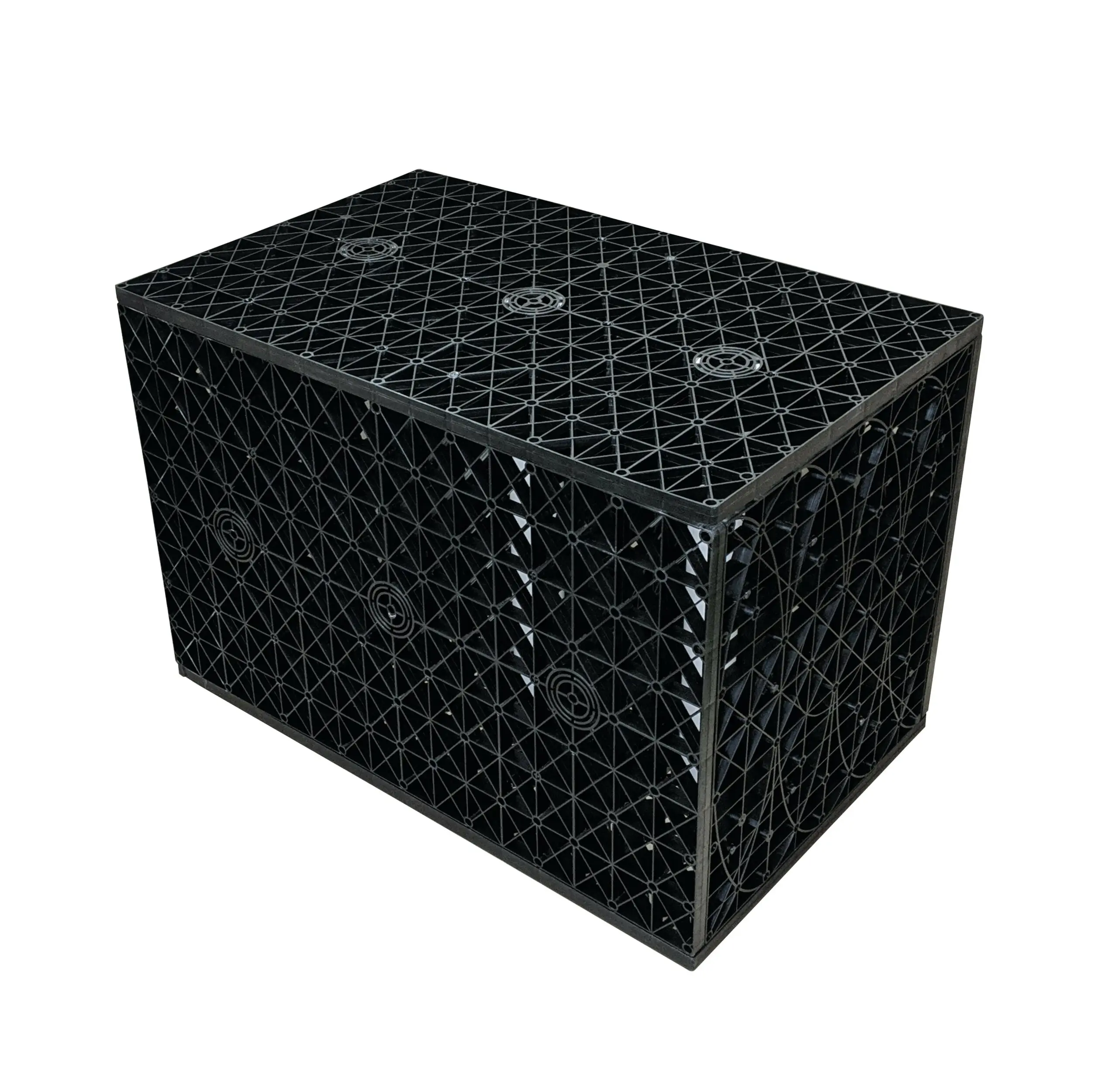
- A soakaway relies on suitable ground infiltration.
- Attenuation needs a controlled discharge route.
- Crate loading, cover and configuration must suit the project.
- Inlets, silt management, inspection and overflow need early coordination.
How a soakaway works
A soakaway receives surface water, stores it within a void and allows it to disperse into the surrounding soil. Modular crates can provide that storage volume while a suitable geotextile wrap allows water to pass into the ground.
The approach only works where infiltration testing and the wider site conditions support it. Groundwater, nearby structures, boundaries and local drainage requirements also affect whether infiltration is appropriate.
How attenuation works
An attenuation system holds water back and releases it at an agreed rate. It normally uses a sealed storage zone, a defined outlet and flow-control arrangement, together with coordinated inlet, overflow and access details.
Calling any crate system an attenuation tank does not establish hydraulic or structural suitability. Storage, discharge, loading, groundwater and design life all need to be checked.
Structural design still matters
Below-ground crates may sit beneath gardens, pedestrian areas, roads or trafficked yards. Cover, live load, soil pressure, groundwater and the proposed configuration affect the structural demand.
A product selected for a shallow domestic soakaway should not be assumed suitable beneath commercial traffic. Ask for current product data and project-specific advice.
Questions to resolve early
Water management works best when the destination of the water is agreed before products are selected. The following inputs help establish the correct route.
- Catchment, design rainfall and required storage volume
- Infiltration test results and groundwater information
- Proposed outfall and any permitted discharge rate
- Cover, loading, levels and available footprint
- Inlets, silt control, inspection, maintenance and overflow
Evidence used for this guide
Questions about water management
Can a soakaway be installed in clay?
A soakaway depends on measured infiltration performance. Clay or other low-permeability ground may be unsuitable, so do not select an infiltration system without suitable evidence.
Do attenuation crates need a membrane?
Attenuation normally requires a sealed storage arrangement, but the liner, protection and jointing strategy must be designed for the project and coordinated with inlets, outlets and groundwater conditions.
Are soakaway crates load bearing?
Crates have defined structural properties and installation requirements. Suitability depends on the product, configuration, cover, surrounding material and imposed loads.